PNC Bank Brings USDC Payments To Corporate Clients – What It Means For Crypto Adoption
英文原文查看譯文
閱讀字級閱讀正文 ↓
載入圖片中
One of America’s largest banks is taking another step into blockchain-based payments. PNC Bank has introduced a new service allowing eligible corporate clients to receive USDC stablecoin payments and convert them directly into U.S. dollars. The development raises an important question: are stablecoins becoming a practical alternative to traditional payment infrastructure? On November 9, PNC […]

One of America’s largest banks is taking another step into blockchain-based payments. PNC Bank has introduced a new service allowing eligible corporate clients to receive USDC stablecoin payments and convert them directly into U.S. dollars. The development raises an important question: are stablecoins becoming a practical alternative to traditional payment infrastructure?
On November 9, PNC announced a limited pilot that integrates USDC payments into its existing corporate banking services.
Rather than requiring businesses to hold cryptocurrency, the system automatically converts incoming USDC into dollars before depositing the funds into a designated bank account.
We believe the most interesting part of this announcement is not the stablecoin itself, but how traditional banks are beginning to incorporate blockchain technology into everyday financial operations.
PNC Bank Introduces Stablecoin Payments For Businesses
According to PNC’s official announcement, eligible corporate and institutional banking clients can receive USDC payments on the Ethereum blockchain.
The service uses payment infrastructure provided by Coinbase, although PNC remains responsible for the banking relationship and associated treasury management services.
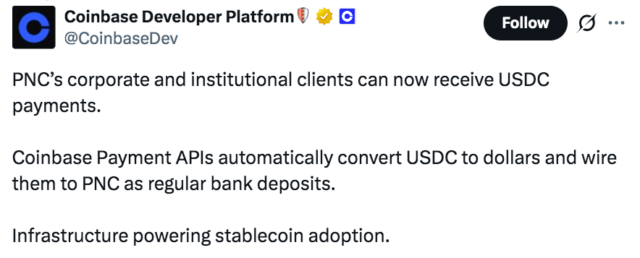
Incoming USDC is converted into U.S. dollars at a 1:1 rate and deposited into the client’s PNC account.
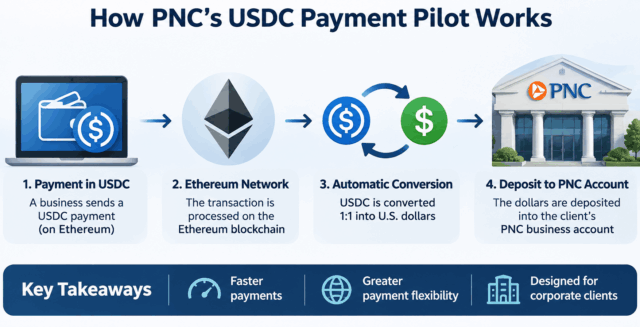
This arrangement allows businesses to experiment with blockchain payments without fundamentally changing how they manage their cash balances.
Tom Lang, Head of Treasury Management Product and Operations at PNC Bank, explained that corporate clients are increasingly exploring new ways to transact with customers, suppliers, and business partners.
He said the initiative combines innovative payment capabilities with the banking experience and risk management that clients expect from PNC.
Importantly, the bank has not announced a nationwide rollout. The service remains available only to selected clients participating in the pilot.
Why Stablecoin Payments Could Change Corporate Banking
Traditional international payments can involve multiple intermediaries, different banking systems, and settlement delays.
Stablecoins offer another way to transfer dollar-denominated value across blockchain networks.
For companies operating internationally, the potential advantages include faster access to funds, greater payment flexibility, and improved efficiency.
However, blockchain settlement alone does not eliminate every delay or expense associated with international transactions. Compliance checks, currency conversion, banking procedures, and payment-processing costs can still apply.
Alec Lovett, Head of Infrastructure Products at Coinbase, described the broader development in the official announcement:
“Stablecoins are modernizing how businesses move money by making payments faster, more efficient and more global”. “Our work with PNC shows how leading banks and trusted digital asset infrastructure come together to let corporate clients take advantage of this technology.”
The statement reflects growing institutional interest in integrating digital assets with established financial services.
As Bitcoinist previously reported, Visa expanded USDC settlement for U.S. financial institutions, highlighting another example of blockchain-based payment infrastructure entering mainstream finance.
The difference is that PNC’s pilot focuses specifically on businesses receiving stablecoins and converting them into conventional bank deposits.
Ethereum Could Benefit From Growing Stablecoin Adoption
Because the PNC service uses USDC on Ethereum, the development also highlights the network’s continuing role in institutional digital payments.
Ethereum provides the blockchain infrastructure on which these transfers take place.
As stablecoin adoption grows, increased transaction activity could support demand for blockchain settlement services.
However, we should distinguish between greater stablecoin usage and immediate upward pressure on ETH prices.
Higher transaction activity does not necessarily produce a proportional increase in token demand, particularly when fees, transaction sizes, and network conditions vary.
Bitcoinist previously examined Ethereum stablecoin transactions, finding that business-related activity represented a substantial share of stablecoin transfer volume.
The PNC announcement provides another example of how institutional use cases could expand beyond cryptocurrency trading.
Are Banks Changing Their Approach To Stablecoins?
For years, stablecoins were frequently discussed as potential competitors to traditional banking products.
However, recent developments suggest that banks are also exploring ways to incorporate these assets into their existing services.
In October, Bitcoinist reported that the OCC encouraged community banks to consider opportunities under the evolving U.S. stablecoin framework.
PNC’s initiative approaches the market from a different direction. Instead of issuing its own stablecoin, the bank is allowing clients to receive an established dollar-backed token.
This could become an attractive model for financial institutions that want to offer blockchain payment capabilities without requiring customers to manage digital assets directly.
Still, several questions remain unanswered.
PNC has not disclosed how many businesses are participating, how much payment volume the service is processing, or when broader availability might begin.
Those figures will be important in determining whether stablecoin payments are becoming a meaningful business activity rather than remaining an experimental offering.
What Comes Next For USDC And Institutional Adoption?
The PNC pilot represents another step toward connecting traditional banking infrastructure with blockchain-based payments.
Its long-term significance will depend on whether corporate clients find the service useful enough to incorporate into regular operations.
We will be watching for additional participants, increased transaction volumes, and possible expansion beyond incoming USDC payments.
For now, the development reinforces a broader trend: major financial institutions are increasingly testing how stablecoins can work alongside existing banking systems rather than replacing them.
If these experiments develop into widely used commercial services, stablecoins could become an increasingly important part of global payment infrastructure.