Binance Restores HYPE, APT as Data Reveals Billions in Reserve Outflows
英文原文查看译文
阅读字号阅读正文 ↓
加载图片中
Binance restored withdrawals for the altcoins hyperliquid (HYPE) and aptos (APT) on Sunday, Nov. 8, advancing its recovery from the $6.3 billion October hack. Meanwhile, Cryptoquant’s latest exchange metrics reveal substantial declines in bitcoin, ethereum, and stablecoin reserves, even as daily withdrawal pressures appear to be easing. Binance Withdrawal Recovery Advances After Historic $6.3 Billion […]
Key Takeaways
• Binance reopened HYPE and APT withdrawals on Nov. 8, ahead of its previously announced target.
• Cryptoquant data shows Binance’s bitcoin reserves falling approximately 56,000 BTC since before the hack, while ethereum holdings declined roughly 400,000 ETH.
• Ethereum-based stablecoin reserves have contracted by approximately $9 billion, although recent daily flows suggest withdrawals are stabilizing.
Binance Withdrawal Recovery Advances After Historic $6.3 Billion Hack
The cryptocurrency exchange continues to gradually restore services following the Oct. 29 attack, which saw approximately $6.3 billion stolen from hot wallets across multiple blockchains. The incident, attributed by blockchain investigators and U.S. authorities to North Korean hackers, ranks as the largest cryptocurrency theft recorded in dollar terms.
On Sunday, Binance announced:
“Latest Withdrawal Update. Withdrawals have now been re-enabled for the following networks and assets: HYPE, APT.”
The announcement followed Binance’s Nov. 6 commitment to restore withdrawals for HYPE, APT, INJ, PLASMA, NEAR, and LTC by the end of the following week. The first two assets returned ahead of schedule, while other withdrawal routes remain subject to individual security assessments.
Binance initially resumed withdrawals on Nov. 1, reopening access to major cryptocurrencies across 15 networks. The exchange subsequently expanded support to dozens of additional assets, including tokens operating on Ethereum and Solana.
Although the recovery has progressed, onchain evidence offers a more revealing examination of the financial consequences.
Cryptoquant Shows Bitcoin Reserves Down 56,000 BTC
According to Cryptoquant metrics examined through Nov. 8, Binance’s bitcoin reserves have fallen from approximately 730,000 BTC before the attack to 673,700 BTC, representing a decline of roughly 56,000 BTC, or 7.7%. At bitcoin’s current price of $75,800 on Sunday, that difference represents approximately $4.2 billion in holdings.
The most pronounced withdrawals occurred between late October and early November, when daily bitcoin netflows registered approximately negative 14,500 BTC, 22,000 BTC, 16,500 BTC, and 9,000 BTC.
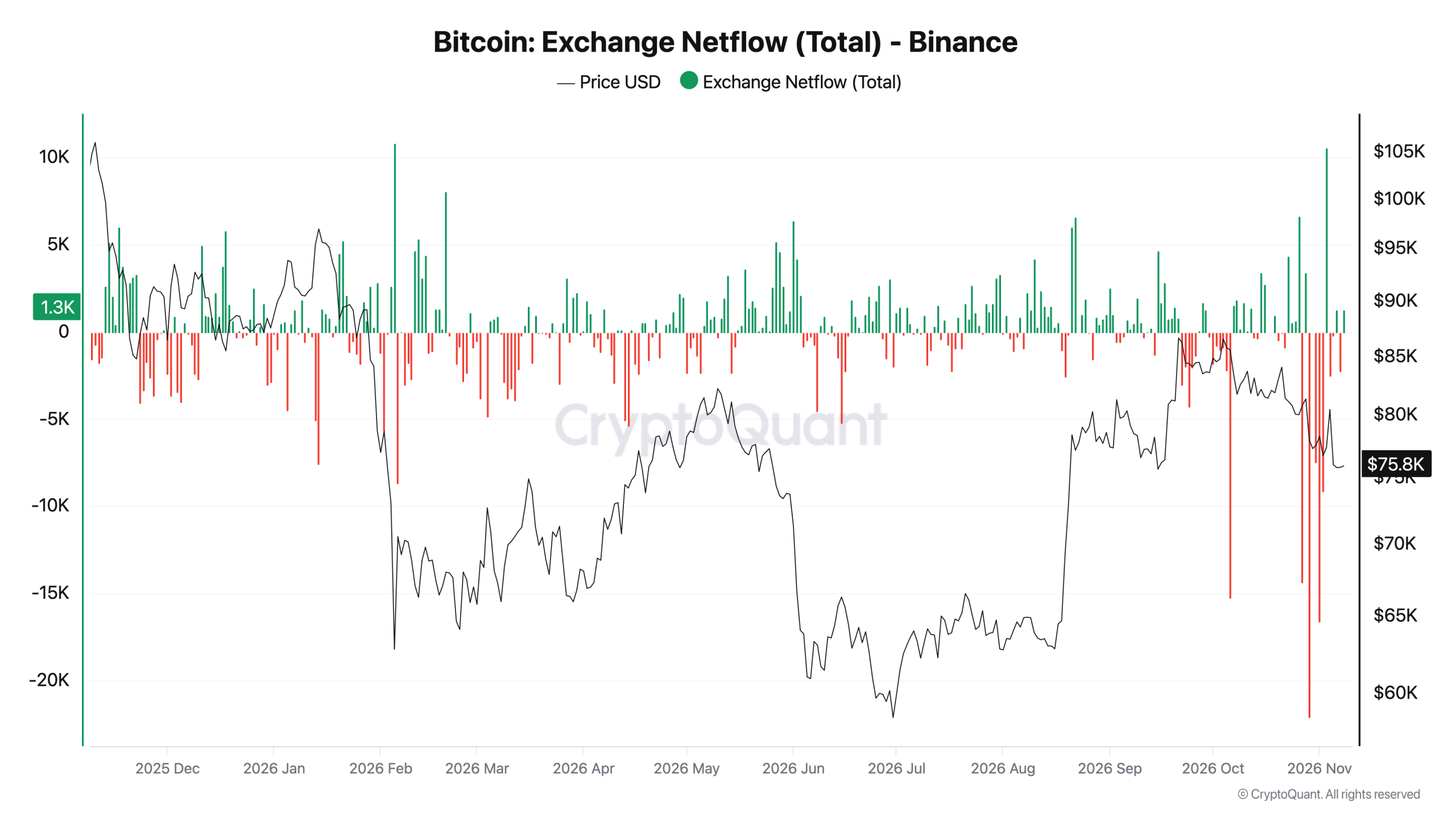
Cryptoquant’s chart shown above tracks net inflows and net outflows on Binance alongside BTC’s U.S. dollar price. Sharp net outflows in early November coincided with bitcoin falling toward $75,000.
The 22,000 BTC withdrawal reading marked the largest daily net outflow across the 12-month stats. However, subsequent activity included a positive 10,400 BTC session, suggesting the initial selling and withdrawal pressures were beginning to dissipate.
The latest reading shows approximately 1,300 BTC in positive daily netflows, a considerable improvement from the extraordinary movements recorded immediately after withdrawals resumed. Ethereum’s numbers tell a somewhat harsher story.
Binance’s ethereum reserves declined from approximately 3.48 million ETH to 3.08 million ETH, a reduction of 400,000 ETH, or 11.5%. Two particularly severe daily netflow readings approached negative 175,000 ETH and 155,000 ETH. The latest daily ethereum netflow remained negative at approximately 5,500 ETH.
Stablecoin Reserves Take the Hardest Proportional Hit
The most conspicuous deterioration appears in Binance’s Ethereum-based stablecoin reserves, which declined from approximately $41 billion before the attack to $32 billion by Nov. 8. That represents a significant contraction of approximately $9 billion, or 22%, substantially exceeding the proportional declines recorded for bitcoin and ethereum.
Two daily stablecoin net outflows approached $3.3 billion and $3.6 billion, roughly triple the largest comparable daily withdrawal previously recorded during 2026. Nevertheless, the latest daily reading showed positive stablecoin netflows of approximately $27.9 million, indicating that the extraordinary withdrawal activity has moderated.
These reserve declines should not be confused with Binance’s previously reported $3.64 billion in net customer withdrawals, equivalent to approximately 2.1% of reported assets. Cryptoquant’s measurements include movements associated with the theft and the Binance hacker, alongside this, the analytic firm’s stablecoin figures cover Ethereum-based tokens rather than every blockchain.
Earlier investigations likewise documented exceptional withdrawal activity following the reopening, alongside evidence that the initial exodus was losing momentum.
Arkham’s $162.65 Billion Snapshot Offers Another Perspective
At the time of writing, blockchain analytics platform Arkham Intelligence places Binance’s labeled cryptocurrency holdings at approximately $162.65 billion across 68.5 million addresses. Its Nov. 8 metrics identify roughly 696,184 BTC and 3.454 million ETH, exceeding Cryptoquant’s respective estimates by approximately 22,500 BTC and 374,000 ETH.
Different wallet attribution methods, blockchain coverage, and reporting methodologies can produce discrepancies between a myriad of analytics providers in 2026. Nevertheless, both datasets identify substantial reserve reductions following the October attack.
Meanwhile, blockchain analytics firm Elliptic recently reported that the attackers converted approximately $174 million in stolen alternative cryptocurrencies into another 2,300 BTC, expanding their bitcoin holdings. Binance reported Nov. 4 that approximately 98% of affected assets had been replenished, with remaining purchases complicated by limited token liquidity.
The central question now extends beyond restoring individual withdrawal services. Binance’s latest flow readings suggest the immediate exodus is subsiding, but its diminished reserves illustrate the financial consequences still visible across the exchange. Operational recovery and the restoration of confidence are related achievements, though the available evidence does not establish that either process is complete.