Ripple’s David Schwartz Reveals Massive XRP And Bitcoin Sales – What Does It Mean For The Market?
Reading sizeRead report ↓
Loading image
Ripple’s former Chief Technology Officer David Schwartz has revealed that he significantly reduced his XRP and Bitcoin holdings over the years, raising questions among investors about what his decisions mean for the cryptocurrency market. However, his explanation suggests that the sales were driven by personal risk management rather than concerns about XRP’s long-term future. In […]

Ripple’s former Chief Technology Officer David Schwartz has revealed that he significantly reduced his XRP and Bitcoin holdings over the years, raising questions among investors about what his decisions mean for the cryptocurrency market. However, his explanation suggests that the sales were driven by personal risk management rather than concerns about XRP’s long-term future.
In a series of posts on X, Schwartz disclosed that his XRP holdings had declined from approximately 26 million tokens to just 3 million. His Bitcoin holdings also dropped dramatically, from around 1,500 BTC to only one BTC.
The revelations attracted considerable attention, particularly as XRP continues to face market volatility and investors look for signs of confidence from influential figures connected to Ripple.
David Schwartz Reveals How Much XRP And Bitcoin He Sold
On November 10, Schwartz addressed speculation surrounding his cryptocurrency holdings and confirmed that he had substantially reduced his exposure to digital assets.
The XRP Ledger co-creator also revealed that his Ethereum holdings had declined from approximately 40,000 ETH to just six ETH.
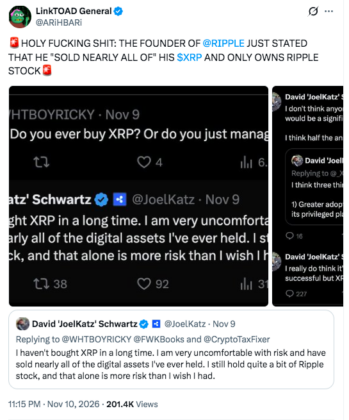
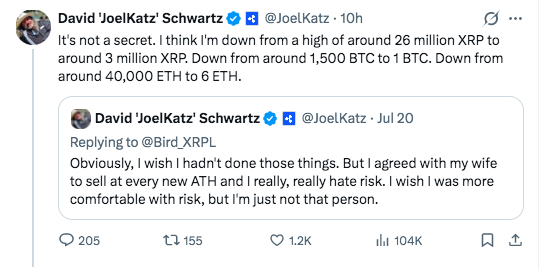
Importantly, these transactions did not happen overnight. Schwartz explained that he gradually sold portions of his holdings over several years, following a personal strategy designed to reduce financial risk.
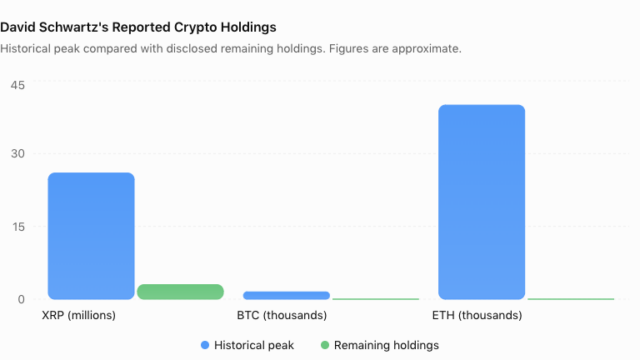
David Schwartz’s reported cryptocurrency holdings show substantial reductions in XRP, Bitcoin, and Ethereum over the years. Source: David Schwartz/X.
In another disclosure, he confirmed selling approximately 2.5 million XRP during 2025, resulting in roughly $1.7 million in capital gains taxes.
According to the IRS digital asset guidance, cryptocurrency transactions can create taxable gains or losses depending on the circumstances.
Schwartz’s comments suggest that his investment decisions were influenced more by financial security than by attempts to predict cryptocurrency market tops.
Why Ripple’s Former CTO Preferred Selling Over Holding
One particularly interesting detail is Schwartz’s explanation of his investment philosophy.
Rather than holding cryptocurrencies indefinitely, he and his wife established a strategy of selling portions of their positions whenever prices reached new all-time highs.
This approach allowed him to secure profits while maintaining some exposure to future market growth.
As Bitcoin and XRP experienced significant appreciation over the years, the strategy also meant that Schwartz missed opportunities for potentially larger gains.
Nevertheless, he emphasized that reducing financial risk was more important to him than maximizing returns.
His comments are consistent with previous statements covered by Bitcoinist, when Schwartz explained that Ripple stock represented a substantial portion of his remaining exposure to the cryptocurrency industry.
This distinction is important because owning shares in Ripple is fundamentally different from holding XRP tokens.
Ripple’s business performance and XRP’s market price are connected through the broader ecosystem, but they are not interchangeable investments.
What Does This Mean For XRP’s Price?
The disclosures arrive during a challenging period for XRP.
On November 11, XRP was trading around $1.06, following renewed selling pressure across the cryptocurrency market.
However, Schwartz’s historical sales should not automatically be interpreted as a bearish signal for the token.
Unlike a sudden exchange deposit involving millions of XRP, a gradual reduction in holdings over several years does not necessarily create immediate selling pressure.
Instead, the market’s reaction may depend on investor sentiment and whether traders interpret the disclosures as a lack of confidence.
As previously discussed in Bitcoinist’s coverage of XRP trading activity, changes in buying and selling behavior can provide important signals about short-term market momentum.
For a convincing recovery, we would want to see stronger spot demand, improving trading volume, and evidence that selling pressure is beginning to stabilize.
A sustained recovery above nearby resistance would strengthen the bullish outlook, while continued weakness could leave XRP vulnerable to additional volatility.
Could Ripple’s XRP Holdings Influence The Market?
Another important consideration is the difference between Schwartz’s personal holdings and Ripple’s corporate XRP reserves.
Ripple continues to maintain substantial XRP holdings, including tokens managed through its escrow system.
Bitcoinist previously examined how XRP escrow arrangements influence the availability of tokens and the broader discussion surrounding market supply.
These corporate holdings are separate from Schwartz’s personal portfolio and should not be confused with his investment decisions.
Although large transactions can influence market sentiment, XRP’s longer-term performance will depend on broader factors, including liquidity, institutional demand, network adoption, and cryptocurrency market conditions.
For now, Schwartz’s disclosures offer an interesting reminder that even some of the industry’s earliest participants approach cryptocurrency investing differently.
His decision to reduce exposure does not necessarily indicate that XRP or Bitcoin have lost their long-term potential.
Instead, the coming months will reveal whether improving market demand and continued blockchain adoption can outweigh the uncertainty currently influencing investor sentiment.